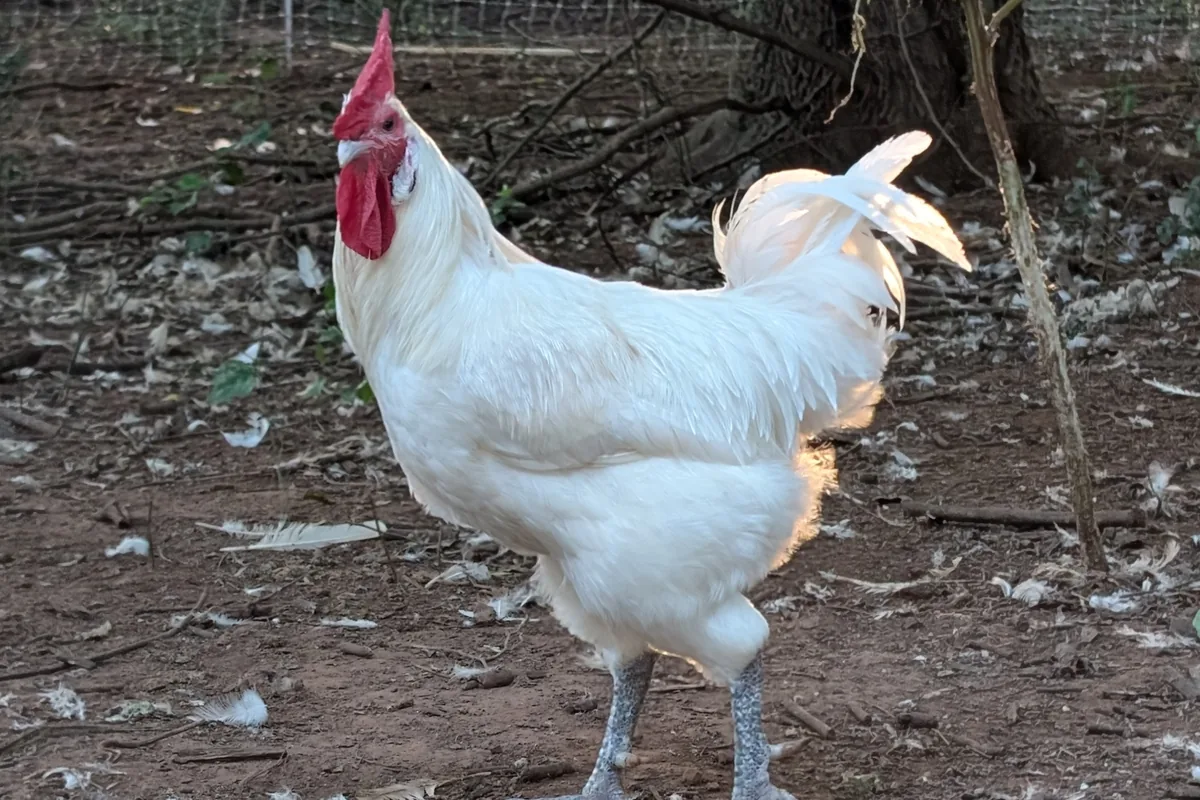
An American Bresse rooster matures at 6–7 pounds. White feathers, upright red comb, slate-blue legs. Most are alert but easy to manage. Keep one rooster per 8–10 hens. A cockerel officially becomes a rooster at one year. Extra males become the point of the breed: table birds at 14–19 weeks.
What is an American Bresse rooster like to keep?
Alert, busy, and easier company than you might fear. A mature male carries 6–7 pounds. White feathers, upright red comb, steel-blue legs. He works the range harder than any hen. He patrols fence lines, calls hens to food he found, and watches the sky. Many keepers report calmer yards than they had with commercial-strain males. Birds still vary, as roosters always have.
Temperament is partly made, not only hatched. Handle cockerels calmly and often, from the brooder on. Move through the flock like you own the ground. Never reward a challenge by backing away. A young male testing you once is normal. A mature male that keeps testing a confident keeper is a cull. That trait breeds forward. The breed standard describes the bird you are aiming for. The full standard lives with the breed's home at AmericanBresse.com.
When does a cockerel become a rooster?
On paper, at one year old. Under twelve months he is a cockerel. Past it, a rooster. In the yard, the change comes in stages you can watch. Sparring and feeder-crowding start around 8 weeks. That is your sort window, 8–10 at the outside, and younger is better. First crows come in the same stretch, croaky before they settle. Fertility arrives over the following months. A cockerel can serve hens before his first birthday. But his body and manners are still developing. By a year, you see the finished bird. That is why breeder picks wait for the full year when they can.
So never judge a five-month-old male harshly on looks alone. Combs, tails, and confidence finish on their own schedule. Many a gawky cockerel grew into the best rooster on the place. The reverse holds too. The early bloomer strutting at twelve weeks is mostly claiming rank. Weigh, handle, and wait. The scale and the calendar judge males better than a first look does.
Which male earns the breeding pen? How many hens does my rooster need? Get Your Answers Live at the Weekly Coffee Hour Q&A.
Join the call on Monday (Free)How many hens per rooster?
Eight to ten hens per rooster keeps a breeding flock fertile. That is enough hens that none get overworked. It is few enough that fertility stays high. A backyard flock does fine with one male over six or more hens. Below about six hens, even a polite rooster's attention gets heavy. You will see worn feathers and stressed birds.
Breeding programs run tighter pens on purpose. One chosen male covers two to four chosen hens. That way every chick's parents are known. The pen's results can be judged fairly next season. Keeping two males? Give them separate territories or a bachelor pen. Two roosters in one small flock tax everyone, hens most of all.
A new male takes a week of patience. Quarantine him first, like any new bird. Then run a see-through fence between him and the flock for several days. Hens accept a rooster they have argued with through wire. A stranger dropped in at dusk gets a fight. Expect a day or two of noise while the pecking order resets. Step in only if feathers fly.
What earns a cockerel a breeding spot
- Weight on schedule. A strong 16-week weight, written down, is the first gate.
- Slate-blue legs. The breed's must-have. Yellow shanks mean a cross, not a keeper.
- Frame and carriage. Broad back, deep breast, upright stance. He should look like work.
- Calm under handling. Easy with you, businesslike with hens, no repeat challenges.
- He beats his brothers. Keep the best male of the hatch, not the first fine one.
What do you do with the extra cockerels?
You eat them. In this breed, that is a privilege, not a consolation. Straight-run hatches are half male. Straight-run means chicks sold unsorted by sex. So the table plan starts on day one. Sort the males at 8 weeks, 8–10 at the outside. Grow them on pasture. Finish them so they land at 14–19 weeks from hatch. One male per hatch might earn the grow-out pen and a shot at breeding. The rest become the finest chicken your kitchen sees all year.
The schedule is kind here, because there is no deadline. A hybrid must be processed on time or the flock starts losing birds. A Bresse cockerel held an extra week or three costs only a little tenderness. Busy month? Processor pushed the date? The birds simply keep ranging. Older males still make fine cooking. The French prize them for braises and stocks, where that deeper flavor belongs.
Decide early which male you are keeping. Watch weights, legs, and manners through the grow-out. Shortlist with the check-card above. Let the table take everyone who misses it. A breeding program is mostly the discipline of eating your second-best birds.
Take the guide with you
This chapter lands in your inbox with the rest of the guide: all 6 chapters. Then the working emails start, one job at a time: penciling the budget, switching feed phases on schedule, making the keep-or-table call. They run until a French-quality table bird comes off your own ground.
Rooster questions, answered
Are American Bresse roosters aggressive?
Most are alert but easy to handle. Many keepers report calmer yards than they had with commercial-strain males. Birds still vary, as roosters always do. Handle them calmly every day from the brooder on. Never back away from a challenge. That keeps most males civil.
How many hens does an American Bresse rooster need?
Eight to ten hens per rooster is the working ratio for a fertile flock. A small backyard flock does fine with one male over six or more hens. Serious breeding pens run one chosen male with two to four hens. That way every chick's parents are known.
When does a cockerel become a rooster?
On paper, at one year old. Under twelve months he is a cockerel. After that, a rooster. In the yard, watch the behavior. Sparring begins around 8 weeks. Crowing and fertility arrive over the next months. By a year he is the finished bird.
What do you do with extra Bresse cockerels?
They become the point of the breed: table birds. Extra males sort out at 8–10 weeks. Finished the traditional way, they reach the table at 14–19 weeks. There is no processing deadline. A late Bresse cockerel costs a little tenderness, never the bird. The best male each season earns a look as a future breeder.
How big does an American Bresse rooster get?
A mature male carries 6–7 pounds on an upright, active frame. White feathers, red comb, and the breed's slate-blue legs. He should feel like an athlete, not a barge. This is a ranging breed, and the males work the yard hardest of all.